(PoliticsWatch posted Sept 23,
2003) OTTAWA -- Both Stephen Harper and Peter MacKay were tight lipped when speaking to reporters today about reports
of renewed talks in Toronto to unite the right.
High-level "emissaries" from both parties are holding talks centred around a 14-point document Harper sent to MacKay a few weeks ago,
aimed at creating a new conservative party and holding an open leadership convention.
"A proposal has been put forward," said Harper. "Some discussions are going on around that and other ideas."
Harper was especially reserved today, most likely in an effort to be sensitive to
the other side because a number of Tories were angered and believe
the Alliance leaked the news of secret discussions to the media
to put pressure on the Tories.
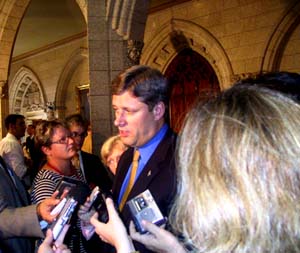 "As you know, I should lower my voice. I'm not supposed to talk about any of this. I'll be very, very quiet," he said with a
smile. Harper then reverted back into
politician mode and said he would not comment on the discussions.
"If and when there is some kind of agreement, I'd certainly be pleased to share
it with you in the media even before I tell my own mother."
Harper said that he thinks a deal is possible because "the silent majority" of both parties wants to see a merger happen.
Harper sounded somewhat upbeat describing the discussions as "progressive" and adding that he had complete confidence in the emissaries to come up with something that would be acceptable to the Alliance
membership.
But MacKay was reserved saying that "there's still a lot of naysayers and a lot of issues that have to be address" and that there were "a lot of moving parts" to the discussions.
Based on MacKay's comments, there appears to be some areas where the Tories will not give ground.
For one, the Alliance and Tories have different leadership selection processes. The Alliance have in place a one-member one-vote system, while the Tories have adopted a delegate selection process.
"That doesn't work for us," said MacKay of the Alliance's system. "Our party made a decision to go to a delegate process. It worked extremely well,
"We're not going to get swamped. Let me be blunt with you. We're not going to go into a process that would allow the province of Alberta alone to elect the leader of a new party. That's not representative of the country. That's not the type of process that would be fair and equal and work, in my view, in the best interest of the entire country."
MacKay also said the party's positions on official languages and equality issues is non-negotiable.
"I want to allay any fears there might be that this party is going to abandon some of its basic values and principles - principles of equality, principles of linguistic duality. These are not the sort of things that we will compromise or throw out the window."
But one area where MacKay said he would give ground would be on his leadership of the party.
"This is politics," he said. "I understand that there are issues that are beyond any personal ambition or any career plans that I might have. This is about the country. This is about the conservative movement. This is about some very weighty, big decisions that will have to be made in the near future."
When CBC reporter Julie Van Dusen, who was the first to break the news of the secret negotiations last week, asked MacKay what
were the stumbling blocks in the negotiations, he smiled and said, "You." MacKay then left the scrum.
Check out these related stories:
 Harper,
MacKay cautious on possible merger
Talks
between MacKay, Harper informal and infrequent
MacKay
"interested" in hearing Harper's vote-splitting
solution
© PoliticsWatch 2003. All
rights reserved. Republication or redistribution of
PoliticsWatch content, including by framing, copying, linking or
similar means, is expressly prohibited without the prior written
consent of Public Interests Research and Communications Inc.
PoliticsWatch is registered trademark of PIRCINC.
|

