|
Infrastructure debate heats up in the
U.S. and Canada
by Romeo St. Martin
[PoliticsWatch updated 3:00 p.m. August 31, 2007]
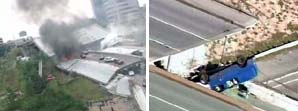 |
| The collapse of a bridge in Minneapolis,
Minnesota, (left) has killed 13 people. A similar collapse in
Laval, Quebec, (right) killed five. |
OTTAWA — A
U.S. bridge collapses in the midst of a presidential election
campaign and politicians from all parties start pointing fingers and
playing the blame game.
An overpass collapses in Canada killing five and the response
is much more measured with the immediate launch of a public inquiry.
These seemingly similar tragedies in Minneapolis, Minnesota, and
Laval, Quebec, highlight the differences between the political cultures
in Canada and the U.S. and just how the debate about eroding infrastructure is being handled in the two countries.
While the Minneapolis incident has become a catalyst for a debate on
infrastructure in American politics, the tragedy in Laval did not do
the same in Canada.
The television pictures and scale of the Minneapolis bridge collapse
was much more dramatic than the section of overpass that
collapsed in Laval. Miraculously, the death toll from the
spectacular Minneapolis collapse has been 13, which is eight more
than were killed in the Laval incident.
Nonetheless, the initial reaction to the I-35 collapse brought
separate trips to the site by U.S. President George W. Bush and
First Lady Laura Bush.
In Canada, the original political symbolic reaction to the Laval
collapse was limited to each of the parties in the House of Commons
having a backbench MP offer their condolences in a statement before
question period. Prime Minister Stephen Harper not only did
not go to the accident site, but his office did not issue a
statement.
Instead, the Harper government quietly took action. Transport
Minister Lawrence Cannon quickly announced after the incident
that all federal bridges would be inspected and confirmed just weeks
later that they were safe for public use.
"We took immediate action to ensure that all federal bridges are safe and secure and that inspections are done on a regular
basis," Cannon said in a statement.
In recent federal budgets, the Conservative government announced a
$33-billion "Building Canada" infrastructure
plan.
"Not since the great national transportation mega-projects of the post-war era has the federal government launched such a massive
undertaking," the prime minister boasted in a June speech to
the Federation of Canadian Municipalities. " This amounts to a coast-to-coast overhaul of the long neglected foundations of our economy."
Despite billions in new spending there are still calls for Ottawa to
do more.
The Canadian Automobile Association estimates that there is a
$22 billion infrastructure deficit for Canada's highway system
alone.
In early August, the CAA released a study that found 41 per cent of
Canadians are concerned about the safety of Canada's highway
system.
"This survey reinforces what CAA has long maintained that with deteriorating infrastructure and increased vehicles on the road, the overall safety of the roads and highways is a concern to motorists," said
CAA president David Armour in a statement.
While the Laval bridge collapse was not the catalyst for a political
debate on infrastructure in Canada, it appears that another incident
in Quebec over the summer may take the debate in that
direction.
In August, a busy section of downtown Montreal was evacuated and
shut down for several days after a crack was detected in an
underground tunnel connected to the city's subway system.
Following the incident in Montreal, NDP Leader Jack Layton
called for an emergency debate in the House of Commons on using the
federal surplus to create an emergency infrastructure fund for
cities.
"In 2007, modern cities like Montreal should never have to shut down their downtown core because of infrastructure failure," Layton said. "The NDP will fight so that it never happens again."
Layton and the NDP have opposition days at their disposal and have
the ability create a full day of debate and a non-binding vote on
infrastructure funding in the Commons this fall.
Click on the story below to get details on how U.S. politicians
are dealing with the infrastructure issue.
 >
The American Infrastructure Debate
U.S. Senator Hillary Clinton is ahead of the other
presidential hopefuls on the infrastructure issue. Find out what George
W. Bush, Rudy Giuliani, Barack Obama, John
McCain, Mitt Romney and others have to say.
© PoliticsWatch® 2006. All rights reserved. Republication
or redistribution of PoliticsWatch content, including by framing,
copying, linking or similar means, is expressly prohibited without
the prior written consent of Public Interests Research and Communications
Inc. (PIRCINC). PoliticsWatch is registered trademark of PIRCINC. |