|
Arctic sovereignty: Priority or
diversion?
by Romeo St. Martin
[PoliticsWatch updated 5:10 p.m., September 7, 2007]
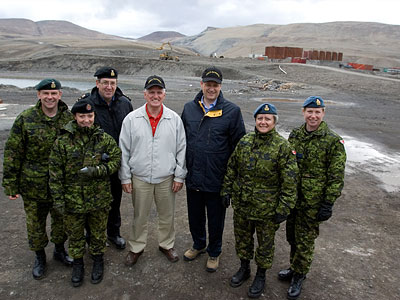 |
| Prime Minister Stephen Harper and former
defence minister Gordon O'Connor pose with Canadian troops
during a recent trip to Canada's North. |
OTTAWA — When
Canadian Prime Minister Stephen Harper shuffled his cabinet on
August 14 he also issued a press release outlining the direction his
government would be taking in the fall.
At the top of the list of priorities was not a perennial
Conservative wish, such as smaller government or tax cuts, nor was
it one of the prime minister's pet projects, such as Senate
reform.
"Assert and defend Canada's sovereignty" was the first
item mentioned in the PM's statement, ahead of crime, the
environment and taxes.
The press release came out just a week after Harper spent several
days touring Canada's northern territories where he made military
funding announcements designed to protect Canada's Arctic
sovereignty claims, so the issue was definitely fresh in the PMO's
mind.
A few weeks later in advance of the North American Leaders'
Summit in Montebello, Quebec, senior Canadian government
officials briefed reporters on what issues Harper would raise during
his bilateral meeting with U.S. President George W.
Bush.
Near the top of that list was Arctic sovereignty.
"Discussion of the Arctic is quite likely given the renewed interest in the Arctic in recent weeks," a senior Canadian government official told reporters in Ottawa.
On the same day, White House reporters were receiving a similar
briefing from Bush administration officials. The issues to be
discussed at the Bush-Harper bilateral were nearly identical to the
ones listed in Ottawa, with the exception that the White House did
not mention the Arctic once.
The Arctic sovereignty issue isn't about to go away.
Documents obtained by Sun Media this week suggest a major Arctic
sovereignty plan could be launched in the throne speech when
Parliament reconvenes on October 16.
According to the Sun, the four-part plan "boosts environmental protection, builds a legal case on territorial boundaries and gives Northerners more control over their economic and political destiny."
Over the summer, Russia planted a flag at North Pole sea bed
as part of its Arctic territorial claim. In addition, Russia
recently announced plans to launch a dozen bombers known as Tupolev 95 "Bears"
to practice firing cruise missiles over the Arctic Circle.
Russia President Vladimir Putin has involved himself heavily
in this issue, including providing a heroes' welcome for the Russian
North Pole expedition team. Putin is rallying his nation around
Russia's Arctic sovereignty claim in a manner reminiscent of the
Cold War era.
The issue is escalating given the latest actions by Russia,
but is it really as big a priority as the Canadian government has
decided it will be?
The government's decision to focus military attention on Arctic
sovereignty also helps serves as a well-timed and welcomed domestic
diversion from the divisive Afghanistan mission.
How divisive has the Afghanistan mission become? The prime minister,
who early in his time in office, made Afghanistan his issue. But
recently, he noticeably failed to mention the word Afghanistan once
during a 20-minute campaign speech in Quebec.
Defending Canada's sovereignty from outside forces, on the other
hand, is something more Canadians can get behind. A recent Angus
Reid poll found that three quarters of Canadians support the
government increasing spending to claim sovereignty over Arctic
territory.
So Arctic sovereignty delivers a two-pronged punch as sound policy
and smart politics.
The Conservatives didn't pull Arctic sovereignty out of a hat over
the summer.
The party made the commitment to build a deep water port in Canada's
north during the 2006 election campaign. After the election, the
plan was originally not popular in military circles, as military
brass thought there were better spending priorities.
This spring, there were questions from politicians in the Nunavut
legislature about whether the federal government was going to live
up to its election commitments.
But after this summer, not only has the Harper government lived up
to the thrust of its promises, but it now seems intent on making
Arctic sovereignty the big issue in the coming months.
Ironically, the man behind the Arctic sovereignty plan was former
defence minister Gordon O'Connor, who has now moved on to
another cabinet portfolio primarily because of his handling of the
war in Afghanistan.
At a press conference following O'Connor's cabinet demotion, Harper
had few words about his handling of Afghanistan, but did praise him
for foresight to see Arctic sovereignty as an emerging issue.
Arctic sovereignty didn't save O'Connor's job at defence, but now
the government is hoping that it will save them in the opinion polls
as the war in Afghanistan continues for at least 15 more
months.
© PoliticsWatch® 2007. All rights reserved. Republication
or redistribution of PoliticsWatch content, including by framing,
copying, linking or similar means, is expressly prohibited without
the prior written consent of Public Interests Research and Communications
Inc. (PIRCINC). PoliticsWatch is registered trademark of PIRCINC. |